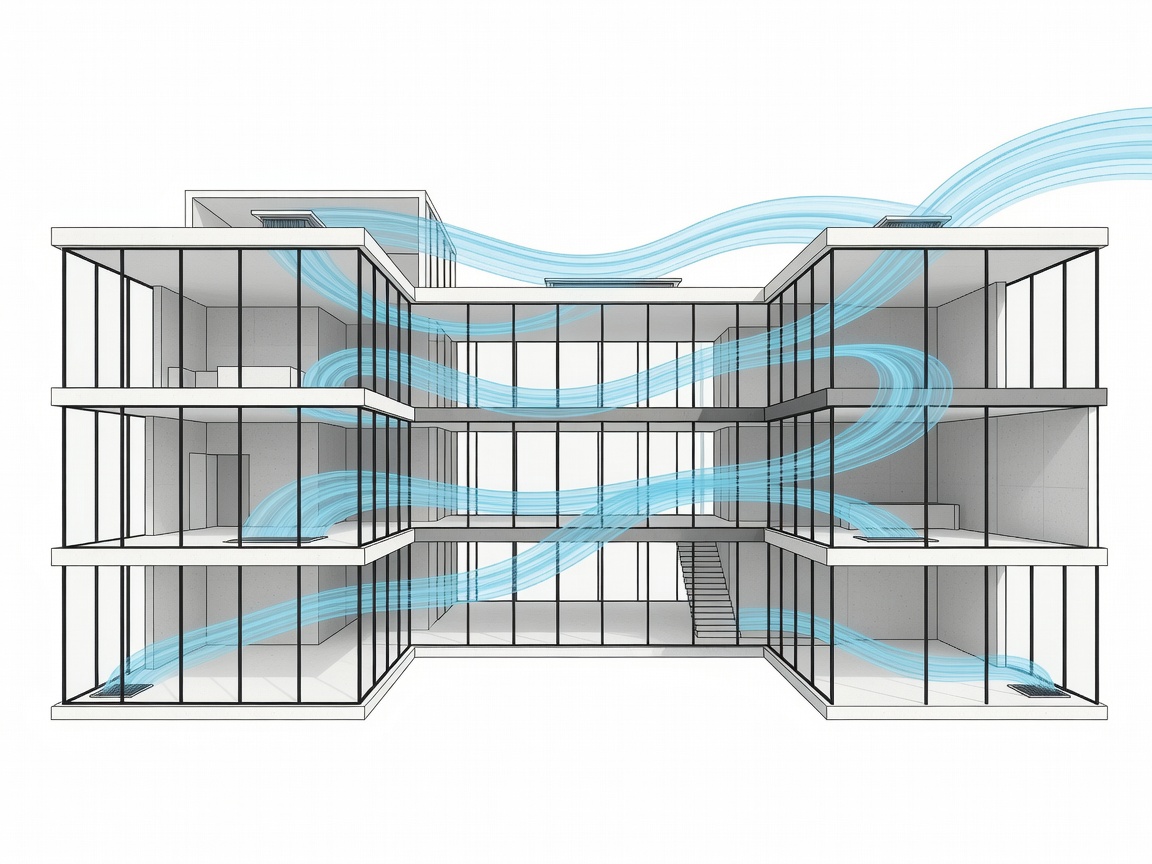
The Purpose of Ventilation
At its core, ventilation is the process of diluting and displacing indoor pollutants. No matter how clean a home is kept, regular human activity generates a continuous stream of carbon dioxide, moisture, particulate matter, and VOCs. If a building is entirely sealed, these pollutants accumulate. Ventilation provides the necessary air exchange rate to keep these concentrations at safe, comfortable levels.
However, bringing in outdoor air presents a physical challenge: temperature control. If you constantly vent heated air to the outdoors during winter, your heating system must work overtime to warm the incoming freezing air. Balancing air exchange with energy efficiency is the primary goal of modern ventilation design.
Natural Ventilation
Natural ventilation relies on wind and thermal buoyancy to drive air movement through a building. It is the oldest and simplest form of air exchange.
Cross-Ventilation: This technique involves opening windows or doors on opposite sides of a room or building. Wind pressure against the windward side of the building pushes air in, while negative pressure on the leeward side pulls it out. This rapid exchange can clear out cooking odours or accumulated heat very efficiently.
Stack Effect: Hot air rises. By opening high windows (like skylights or upper-storey windows) and low windows simultaneously, the warmer indoor air escapes through the top, creating a vacuum that pulls cooler outdoor air in through the bottom. This is particularly effective during cooler evenings following hot days.
While free and effective, natural ventilation is highly dependent on weather conditions. It also offers no filtration; if the outdoor air is high in pollen, smoke, or pollution, natural ventilation will pull those contaminants directly into the living space.
Mechanical Ventilation
To provide consistent, controllable air exchange regardless of weather, mechanical ventilation is required. There are three primary types of mechanical ventilation used in residential structures.
Exhaust-Only Systems
These systems use fans (like bathroom and kitchen extractors) to pull stale air out of the building. This creates a slight negative pressure inside the house, which pulls fresh air in through passive vents, gaps, and cracks in the building envelope. While inexpensive to install, these systems do not control where the fresh air comes from, and they pull in unconditioned (hot or cold) air, leading to higher energy bills.
Supply-Only Systems
The inverse of exhaust systems, supply systems use a fan to draw outside air in, creating positive pressure that pushes stale air out through exhaust vents or building leakage. The advantage here is that the incoming air can be filtered and sometimes dehumidified. However, pushing warm indoor air out through wall cavities during winter can cause condensation and hidden moisture damage.
Balanced Systems: HRVs and ERVs
The gold standard for residential ventilation is a balanced system. These systems utilise two fans: one pulling fresh air in, and one blowing stale air out, keeping the pressure neutral.
To solve the energy penalty of bringing in unconditioned air, these systems incorporate heat exchangers. A Heat Recovery Ventilator (HRV) passes the outgoing heated air and incoming cold air through a conductive core. The air streams never mix, but the heat from the exhaust air transfers to the incoming air, pre-warming it and saving massive amounts of energy. An Energy Recovery Ventilator (ERV) functions similarly but also transfers moisture, helping to maintain stable indoor humidity levels year-round.